LangChain middleware reference
Module: piighost.integrations.langchain
PIIAnonymizationMiddleware is a LangChain AgentMiddleware that de-identifies confidential data around the model and tool boundary of an agent. It reads the thread id from the LangGraph config, de-identifies messages before the model sees them, restores them after for display, and routes tool calls by a chosen strategy. All detection, token assignment, and replacement is delegated to a ThreadAnonymizationPipeline.
from piighost.integrations.langchain import (
    EntityCreateByAssistantStrategy,
    InventedPlaceholderStrategy,
    PIIAnonymizationMiddleware,
    ToolCallStrategy,
)
Needs the langchain extra (pip install piighost[langchain]), which pulls in langchain. Importing the package never pulls langchain in. The middleware class is imported on demand, so a missing extra raises an ImportError naming the extra.
PIIAnonymizationMiddleware
Extends AgentMiddleware and hooks the agent loop at three points.
| Hook | When | Operation |
|---|---|---|
abefore_model | Before each model call | De-identifies the user and model messages |
aafter_model | After each model response | Restores the user and model messages for display |
awrap_tool_call | Around each tool call | Restores the arguments, de-identifies the response, per strategy |
Constructor
PIIAnonymizationMiddleware(
    pipeline: AnyThreadPipeline[IdentityT],
    tool_strategy: ToolCallStrategy = ToolCallStrategy.FULL,
    invented_strategy: InventedPlaceholderStrategy = InventedPlaceholderStrategy.RAISE,
    assistant_strategy: EntityCreateByAssistantStrategy = EntityCreateByAssistantStrategy.PRESERVE,
)| Parameter | Type | Description |
|---|---|---|
pipeline | AnyThreadPipeline[IdentityT] | The thread pipeline that de-identifies and restores (required) |
tool_strategy | ToolCallStrategy | How the two directions of a tool call are handled |
invented_strategy | InventedPlaceholderStrategy | How a token the pipeline never issued is treated after restoration |
assistant_strategy | EntityCreateByAssistantStrategy | How values the assistant introduces are treated |
The pipeline must expose a delimited token recognizer through pipeline.recognizer, so a token the model invented can be found again. A pipeline whose placeholder factory is not delimited (a mask, for example) has no recognizer, and the constructor raises UnrecognizableFactoryError. The IdentityT type bound enforces the same at type-check time for typed callers.
Every agent call carries a thread id in its LangGraph config. A call without one raises MissingThreadIdError. The middleware does not route that call into a shared thread, because placeholder state would then leak across conversations. If your conversations need no separation, name the "default" thread (DEFAULT_THREAD_ID) yourself.
Hooks
abefore_model(state, runtime) -> dict | None
De-identifies the user and model messages before the model sees them. Each message is passed through pipeline.anonymize() under the role given by its message type. A ToolMessage is never rewritten here, only in the tool wrapper. Under EntityCreateByAssistantStrategy.IGNORE, AIMessage content is skipped entirely.
Returns {"messages": [...]} when a message changed, None otherwise.
# before: [HumanMessage("Email Patrick in Paris")]
# after:  [HumanMessage("Email <<PERSON:1>> in <<LOCATION:1>>")]
aafter_model(state, runtime) -> dict | None
Restores the user and model messages for display through pipeline.deanonymize(), then applies invented_strategy to the restored text. Returns {"messages": [...]} when a message changed, None otherwise.
# before: [AIMessage("Sent to <<PERSON:1>>.")]
# after:  [AIMessage("Sent to Patrick.")]
awrap_tool_call(request, handler) -> ToolMessage | Command
Routes the tool call by tool_strategy. When the strategy de-identifies input, the tool arguments are restored to real values before the tool runs. When it de-identifies output, a string tool response is passed through pipeline.anonymize() after the tool runs. PASSTHROUGH touches neither.
Argument restoration recurses through nested dict, list, and tuple containers. Only str leaves are restored, other types pass through unchanged.
The response is de-identified whichever shape the tool replied with. The tool can return its ToolMessage directly, or a Command whose state update carries that ToolMessage. A tool that also writes state uses this second shape. A state update is walked in both its forms, a mapping of state keys or a sequence of key-value pairs. Each entry holds one message or a sequence of messages. All four forms LangGraph accepts are therefore covered. Content that is a list of text blocks is handled the same way as a plain string, block by block.
# model calls  : send_email(to="<<PERSON:1>>", subject="Hi")
#                       restore args
# tool receives: send_email(to="Patrick", subject="Hi")
# tool returns : "Sent to Patrick."
#                       de-identify response
# model sees   : "Sent to <<PERSON:1>>."
Strategies
Plain enums in piighost.integrations.langchain.strategy, importable without langchain.
ToolCallStrategy
How the two directions of a tool call are handled. The directions are independent, and the middleware acts only in the tool wrapper.
| Value | Arguments | Response |
|---|---|---|
INPUT | restored to real values | left as the tool returned it |
OUTPUT | left tokenized | de-identified |
FULL | restored to real values | de-identified |
PASSTHROUGH | untouched | untouched |
FULL is the default. A strategy that does not de-identify the response leaves it as the tool returned it, and the model sees it that way.
InventedPlaceholderStrategy
How a token the pipeline never issued is treated. After restoration, every issued token has been replaced by its value. Any token still matching the placeholder grammar was therefore invented by the model, whether hallucinated or injected.
| Value | Effect |
|---|---|
KEEP | leave the invented token in the text |
DROP | remove the invented token |
RAISE | raise InventedPlaceholderError |
RAISE is the default.
EntityCreateByAssistantStrategy
How values the assistant introduces are treated. A value's provenance is the role of its first occurrence in the thread. A value the assistant introduced is not the user's confidential data. De-identifying it therefore strips the model of its world knowledge of that entity.
| Value | Effect |
|---|---|
PRESERVE | leave assistant-introduced values in clear |
ANONYMIZE | de-identify them like the user's confidential data |
IGNORE | do not analyze assistant messages at all, saving the detector |
PRESERVE is the default.
Full flow
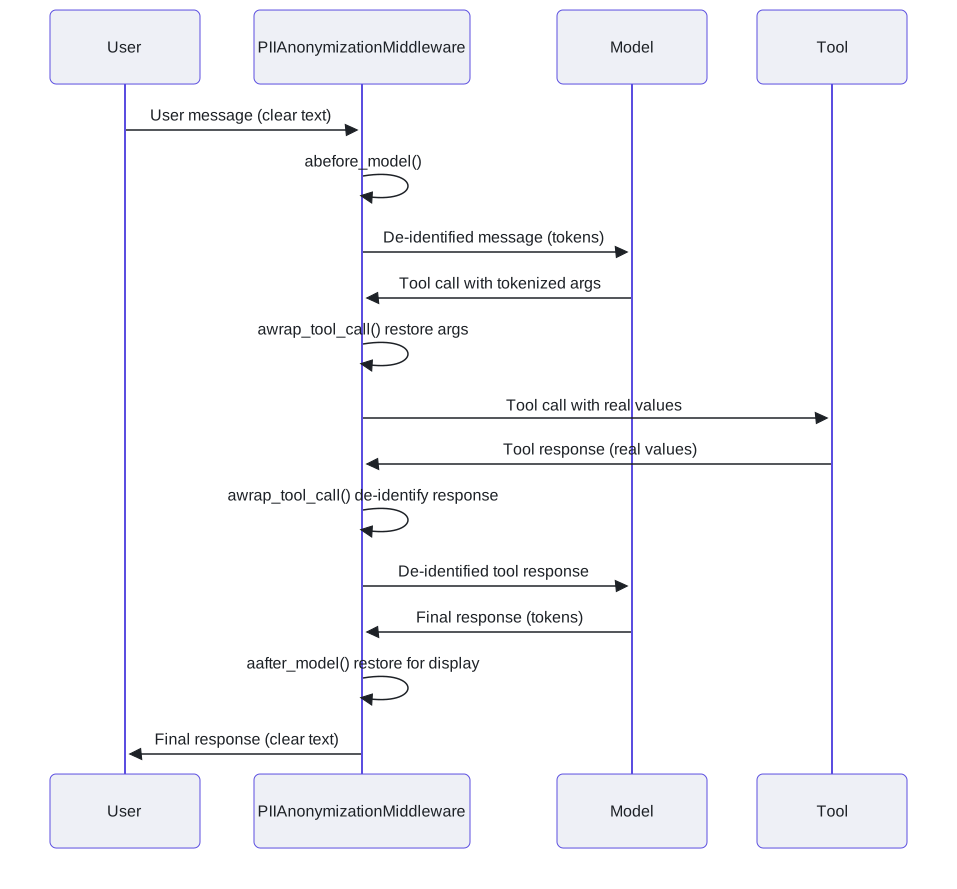
From the user message to the restored response, through the model and the tool.
Example
from langchain.agents import create_agent
from langchain_core.tools import tool

from piighost.config import load_thread_pipeline
from piighost.integrations.langchain import PIIAnonymizationMiddleware


@tool
def get_info(person: str) -> str:
    """Return information about a person."""
    return f"{person} is a software engineer in Paris."


pipeline = load_thread_pipeline("pipeline.toml")
middleware = PIIAnonymizationMiddleware(pipeline)

agent = create_agent(
    model="openai:gpt-5.6-terra",
    system_prompt="You are a helpful assistant. Treat placeholders as real values.",
    tools=[get_info],
    middleware=[middleware],
)

config = {"configurable": {"thread_id": "conv-1"}}
result = await agent.ainvoke(
    {"messages": [{"role": "user", "content": "Who is Patrick?"}]},
    config,
)
print(result["messages"][-1].content)
The pipeline must be a thread pipeline whose placeholder factory is delimited, such as label, label_counter, or label_hash. Pass a thread id on every call through config["configurable"]["thread_id"], or the call raises MissingThreadIdError.
Streaming
The abefore_model and aafter_model hooks see the whole message. A live display that streams the reply would therefore show placeholders until it completes. For a token-by-token display, wrap deanonymize_stream around your own streaming loop. It buffers only a token split across chunks, restores each token once it completes, and applies invented_strategy per restored token.
deanonymize_stream(source, thread_id) -> AsyncIterator[str]
source is an async iterator of the model's text chunks. thread_id is the id you ran the agent with. You pass it yourself, because a manual stream loop does not see the LangGraph config the hooks read.
from langchain_core.messages import AIMessage

config = {"configurable": {"thread_id": "conv-1"}}


async def model_text():
    async for chunk, _meta in agent.astream(
        {"messages": [{"role": "user", "content": "Who is Patrick?"}]},
        config,
        stream_mode="messages",
    ):
        # The stream carries the tool results too, keep the model's text only.
        if isinstance(chunk, AIMessage) and isinstance(chunk.content, str):
            yield chunk.content


async for restored in middleware.deanonymize_stream(model_text(), "conv-1"):
    print(restored, end="", flush=True)
A token split across chunks, <<PER then SON:1>>, is held until it completes and restored to Patrick, so the display shows no broken token. Only a stream that stops in the middle of a token emits its fragment as is, for example <<PER. That fragment holds no real value.
For another framework, use the same restoration one step lower. pipeline.recognizer.async_stream_decoder(replace) builds the decoder over any factory's grammar. replace is a coroutine that restores one token.
See also
- Pipeline reference for the thread pipeline the middleware drives.
- Tool-call strategies for the reasoning behind each strategy.
- TOML configuration for building the pipeline from a file.
- Show a streamed reply and Let a tool act on the real values, for the business rules of streaming and tool calls and where each lives in the code.