How to document piighost in a DPIA
A data protection impact assessment (DPIA) describes a processing, weighs its risks to the people concerned, and lists the measures that address them. If your system sends conversations to an LLM through piighost, this page gives your DPO what they need to fill in the parts of the DPIA that concern piighost. It follows the order of Article 35(7) of the GDPR. The legal reading of pseudonymization, and what the Court of Justice held in EDPS v SRB, are on Compliance.
Check whether a DPIA is required
Article 35(1) requires a DPIA before a processing that is likely to result in a high risk, and each supervisory authority publishes a list of the processing operations that require one (Article 35(4)). In France, that is the CNIL list.
The WP248 rev.01 guidelines, adopted by the Article 29 Working Party and endorsed by the EDPB, give nine criteria. In most cases, a processing that meets two of them requires a DPIA. An LLM assistant for a law firm or a notary's office can meet several, among them "sensitive data or data of a highly personal nature" and "innovative use or applying new technological or organisational solutions".
If you conclude that a DPIA is required, gather the facts of your deployment before writing it.
- The configuration file of the pipeline, or the code that builds it.
piighost validatechecks a configuration file. - The detectors and the labels they look for.
- The placeholder factory.
- The memory backend, and whether a hasher and a cipher protect it.
- The guard rail, if any.
- The observation redactor, if traces are exported.
- The integration (LangChain middleware, Pydantic AI, LlamaIndex, Claude Code hooks, remote client) and, for the LangChain middleware, the tool-call strategy.
Describe the processing
Article 35(7)(a) asks for a systematic description of the processing. For the part piighost performs, it comes down to four steps.
- Detection. The configured detectors find the PII in each message, a name, an email, an IBAN. Only what they recognize is replaced. The regex patterns and the NER models run locally. An
LLMDetectorruns wherever its chat model runs. A regex group of the catalog pinned to a commit is fetched once, as patterns only, then read from the local cache. No message text is sent to the catalog. - Replacement. Each detected value is replaced by a token before the text leaves for the LLM provider. Patrick becomes <<PERSON:1>>, and stays <<PERSON:1>> for the whole conversation.
- Retention of the mapping. The mapping from <<PERSON:1>> back to Patrick is kept in the conversation memory, partitioned by conversation (
thread_id). - Restoration. When the reply comes back,
piighostputs Patrick back in place of <<PERSON:1>> for the user. With the LangChain middleware, the tool-call strategy decides whether tools receive real values too. The default,ToolCallStrategy.FULL, restores the arguments of a tool call and de-identifies its result.
Where the mapping lives
The mapping is what the GDPR calls additional information, and it holds the values in clear. Record where it lives.
| Memory backend | Where the mapping lives | Survives a restart | At-rest protection | Extra |
|---|---|---|---|---|
InMemoryConversationMemory (default) | the memory of the application process | no | none | core |
RedisConversationMemory | a Redis server | yes, with an optional ttl | opt-in hasher and cipher | redis |
SqlAlchemyConversationMemory | a SQL table (SQLite, PostgreSQL) | yes | opt-in hasher and cipher | sqlalchemy |
PIIGhostClient | the piighost-api server it calls | depends on that server's backend | depends on that server's backend | client |
The hasher and the cipher need the crypto extra, and Argon2Hasher the argon2 extra. The conversation identifier stays in clear in the Redis keys and the SQL table, since it is what lets a conversation be found and erased. Use an opaque thread_id, never an email or a name.
Two other places hold values in clear and belong in the description.
- Each worker keeps a memoized copy of a conversation's tokens in its own memory.
token_memo_ttlbounds how long it lives, see Multi-instance deployment. - With the LangChain middleware, the messages in the LangGraph state hold the restored values after the model turn. A checkpointer that persists that state therefore persists these values too. See Security.
Who can restore
Restoring takes the mapping, so it takes access to the memory backend. It also takes the cipher key when the backend encrypts. In practice, the ones who can restore are the application process and anyone who can read the store and holds PIIGHOST_CIPHER_KEY. When the store is not encrypted, reading it is enough. The LLM provider cannot restore, because it receives only tokens. Recital 29 asks the controller to indicate the authorized persons. Name them in the DPIA.
Map the data flows
The diagram follows Patrick through one turn of a conversation.
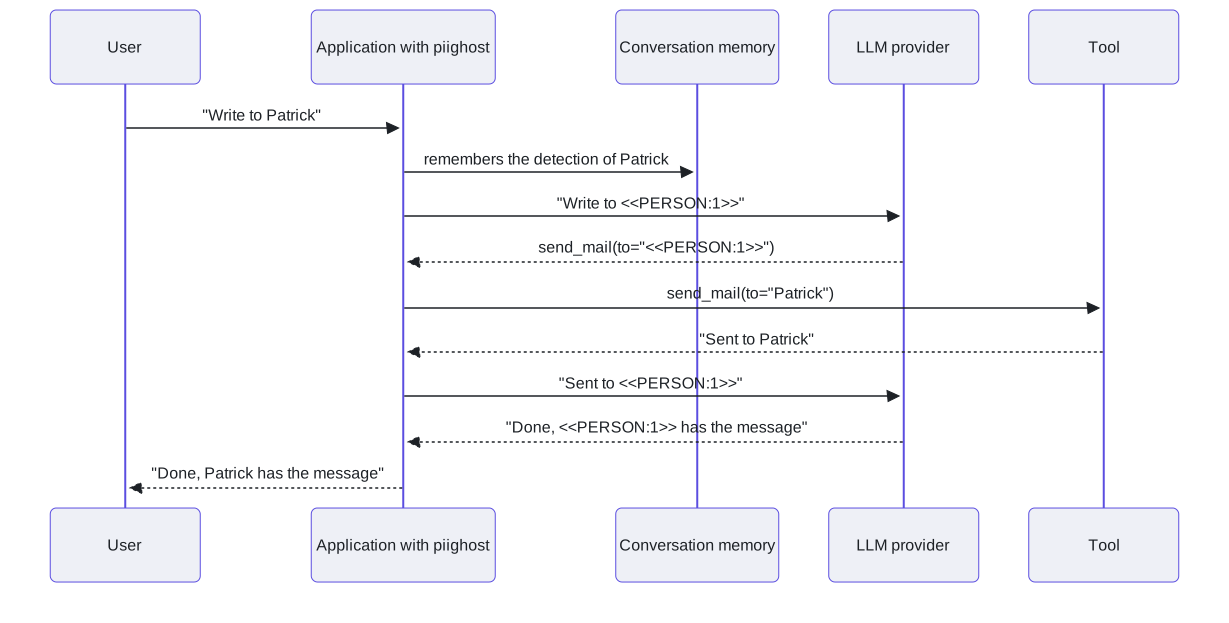
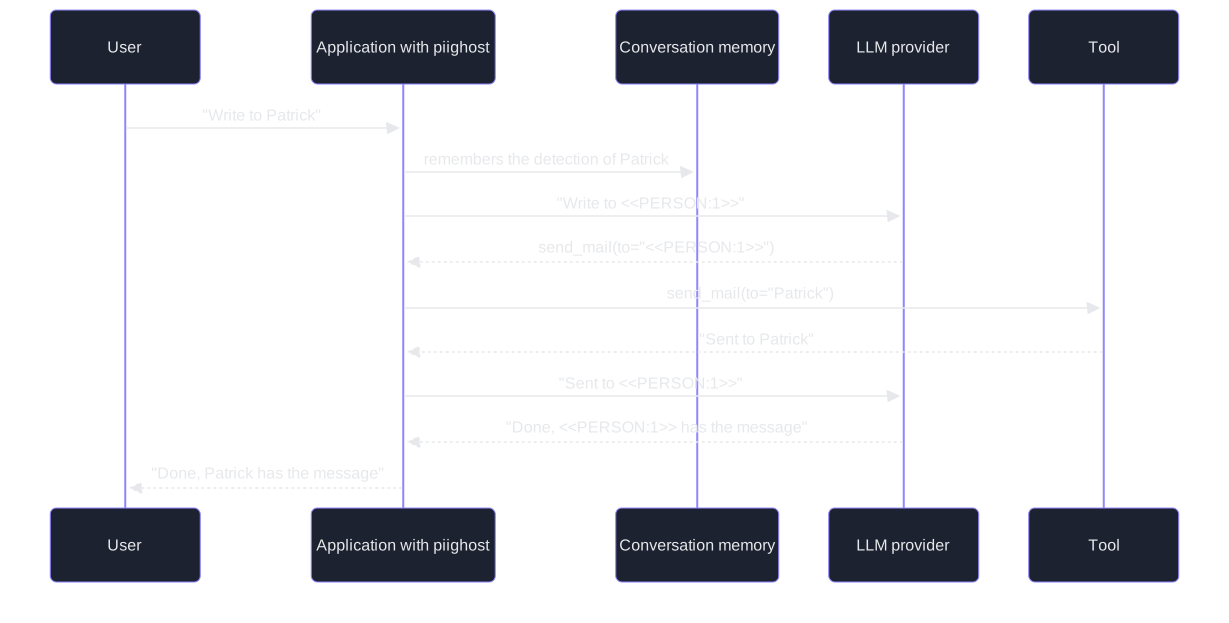
One turn with the LangChain middleware and the default FULL tool-call strategy.
Each flow goes into the DPIA with what crosses it and who receives it.
| Flow | What crosses | Recipient |
|---|---|---|
| User to application | the message in clear | you |
| Application to memory | the detected values, encrypted when a cipher is configured | you, or the host of the store |
| Application to LLM provider | the de-identified text, with everything the detectors did not replace | the LLM provider |
| Application to tool | the restored values, under the FULL and INPUT strategies | the operator of the tool |
| Tool result to LLM provider | the tool's response, de-identified under FULL and OUTPUT, as the tool returned it under INPUT and PASSTHROUGH | the LLM provider |
| Application to trace backend | the stage payloads, tokenized when an observation_redactor is set, in clear otherwise | the operator of the trace backend |
Application to a remote LLMDetector | the message in clear, since detection runs before replacement | the provider of that chat model |
| Application to a remote guard rail | the de-identified output (LLMGuardRail, ModerationGuardRail) | the provider of that model |
Map the measures to the risks
Article 35(7)(d) asks for the measures envisaged to address the risks. The table lists those piighost provides, the setting to record, and the page that details it.
| Risk | Measure | Setting to record |
|---|---|---|
| The LLM provider reads the PII | the values are replaced before the text leaves, and a counter or hash token is never computed from the value it replaces. See Placeholder factories. | the detectors, the placeholder factory |
| The mapping reaches the provider | the mapping stays in the memory on your side and is never sent with the text. See Security. | the memory backend |
| Theft of the persistent store | the key of each message is hashed (Sha256Hasher or Argon2Hasher) and each value encrypted (AesGcmCipher). The hasher and the cipher are configured together or not at all. A networked store built without them emits a PIIGhostSecurityWarning. See Security. | the hasher, the cipher, where PIIGHOST_HASH_PEPPER and PIIGHOST_CIPHER_KEY are kept |
| A PII left in the output | a guard rail re-checks the de-identified text, and the pipeline raises PIIRemainingError when it flags one. See Guard rails. | DetectorGuardRail, Gliner2GuardRail, LLMGuardRail or ModerationGuardRail |
| Logs and traces carry PII | the library writes no PII to its loggers, and an observation_redactor tokenizes the trace payloads. See Observation. | the redactor, trace_clear_text, whether PIIGHOST_HOOK_LOG is unset |
| One conversation sees another's values | the memory is partitioned by thread_id, and the integrations refuse a turn without a thread_id instead of pouring it into a shared thread. See Limitations. | how thread_id is derived |
| A user types a token to read someone else's value | a token typed in the input is neutralized before rendering (escape_existing_tokens=True by default). See Security. | left at its default |
| The LLM makes up a token | an invented token is refused by default (InventedPlaceholderStrategy.RAISE). See Tool-call strategies. | the strategy |
| Retention, and a request for erasure | forget_thread erases a conversation from the memory and the local token memo, and returns how many messages and detections it dropped. See Pipeline reference. | the retention rule, max_threads and ttl on the in-memory backend, ttl on Redis, token_memo_ttl |
The debug log of the Claude Code hooks, written only when PIIGHOST_HOOK_LOG is set, can contain restored values. Leave it unset in production.
Record the residual risks
Article 35(7)(c) asks for an assessment of the risks. piighost lowers the exposure toward the LLM provider without removing the following risks, to record as residual.
- Detection is not exhaustive. A PII the detectors do not recognize reaches the provider in clear. A NER model can also truncate a text longer than its context. See Limitations.
- Context and quasi-identifiers stay in clear. "<<PERSON:1>>, the only notary in a village of 300" identifies a person without naming them. The detectors see values, not that inference.
- The LLM can write a PII it invented. A name the model makes up is in no mapping. So nothing ties it to a person, and nothing removes it.
- Values the assistant introduces stay in clear under the default
EntityCreateByAssistantStrategy.PRESERVE.ANONYMIZEtokenizes them too. - The mapping store is a target. It holds the values in clear, or encrypted under a key your environment holds. The process memory and a persisted LangGraph state hold them in clear. See Security.
- Tools receive real values under the
FULLandINPUTstrategies, so every tool the agent can call is a recipient. UnderINPUTandPASSTHROUGH, a PII in a tool's response reaches the provider in clear. - Erasure has a scope.
forget_threadreaches the memory and the memo of the process that runs it. It does not reach the provider's logs, your checkpointer, your traces, or the memo of another worker before itstoken_memo_ttlruns out. - The provider's position is not settled. A DPIA that treats the de-identified text as personal data for the provider holds whichever way that question is settled. See Compliance.
Fill in the template
Copy the table into your DPIA and fill in the last column for your deployment. It follows the four items of Article 35(7). You can carry it into the DPIA template of the EDPB, adopted on 14 April 2026 for public consultation, or into the CNIL method and PIA software (in French).
| Article 35(7) | Item | What to record | Your deployment |
|---|---|---|---|
| (a) description | purpose | what the LLM assistant is used for | |
| (a) description | detectors | the detectors, the labels they look for, the languages they cover | |
| (a) description | placeholder | the factory and an example token | |
| (a) description | mapping | the memory backend, its host, its retention | |
| (a) description | recipients | the LLM provider, the tools, the trace backend, any remote detector or guard rail | |
| (a) description | restoration | who can restore, and with which access | |
| (b) necessity | minimization | why the provider needs the de-identified text, and why the tools need real values | |
| (c) risks | residual | the residual risks above that apply, with their likelihood and severity | |
| (d) measures | crypto | the hasher, the cipher, where the secrets live | |
| (d) measures | guard | the guard rail, or why there is none | |
| (d) measures | logging | the observation redactor, the application logs, the checkpointer | |
| (d) measures | isolation | how thread_id is derived, and that it is opaque | |
| (d) measures | erasure | when and by whom forget_thread is called, and what it does not reach | |
| (d) measures | provider | the processor contract, retention and training terms, the transfer outside the EU if any |
See also
- Compliance: the GDPR provisions, the EDPB guidelines and the EDPS v SRB judgment on pseudonymization.
- Security: the threat model, the memory backends, and the at-rest crypto.
- Limitations: what detection misses, and how to mitigate it.
- Deployment: bounding the memory and running
piighostin production.